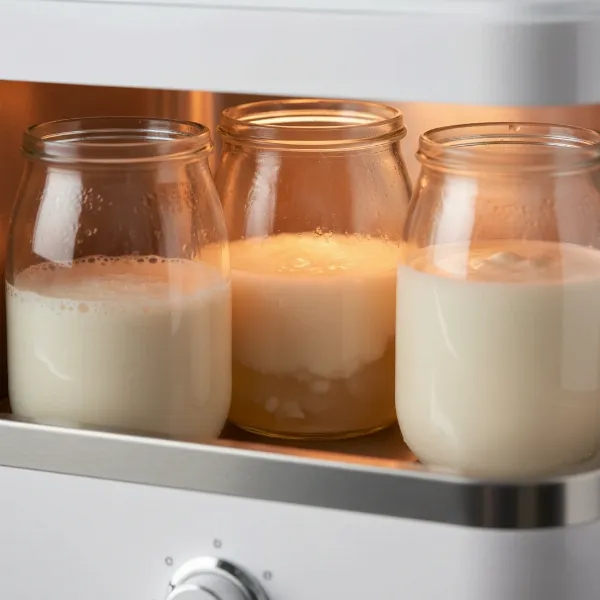
The pursuit of perfect homemade yogurt often leads enthusiasts down two popular paths: the versatile Instant Pot and the specialized dedicated yogurt maker. Both promise creamy, tangy results, but which appliance truly delivers a superior experience and a better final product? This comprehensive guide dives deep into their functionalities, comparing their strengths and weaknesses to help you decide which tool best fits your culinary aspirations and lifestyle.
Understanding the Yogurt Making Process
Making yogurt at home is a simple yet scientific process, hinging on the careful orchestration of temperature and time. Milk is first heated to denature proteins and kill unwanted bacteria, then cooled to an ideal temperature before a live starter culture is introduced. This starter culture, containing beneficial bacteria like Lactobacillus bulgaricus and Streptococcus thermophilus, then ferments the milk, converting lactose into lactic acid. This acid thickens the milk and gives yogurt its characteristic tangy flavor. The success of this fermentation relies heavily on maintaining a stable, optimal temperature throughout the incubation period.
Instant Pot: The Multi-Cooker’s Take on Yogurt
The Instant Pot, renowned for its multi-functional capabilities, often includes a “Yogurt” setting, tempting users with the promise of one-pot yogurt making. This feature leverages the appliance’s heating element to perform both the boiling and incubation stages.
How Instant Pot Makes Yogurt
|
Our Picks for the Best Yogurt maker in 2026
As an Amazon Associate I earn from qualifying purchases.
|
||
| Num | Product | Action |
|---|---|---|
| 1 | Euro Cuisine Yogurt Maker - YMX650 Automatic Digital Yogurt Maker Machine with Set Temperature - Includes 7-6 oz. Reusable Glass Jars and 7 Rotary Date Setting Lids for Instant Storage |

|
| 2 | Ultimate Probiotic Yogurt Maker with Adjustable Time & Temp Control - Make Trillions of Live Probiotics with Two 1-Quart Containers for Larger Batches - Greek Yogurt Maker - ULTIMATE LIFETIME WARRANTY |
|
| 3 | Yogurt Maker with Adjustable Temperature & Time Control, Probiotic Yogurt Maker Machine with 8 Glass Jars, Automatic Shut-Off for Homemade Probiotic Yogurt, Promoting Gut Health(48OZ) |
|
| 4 | Yogurt Dehydrator, Small-Batch Greek Yogurt Maker with Built-In Date Reminder Fresh, Simple & Just the Right Amount — Food-Grade BPA-Free Materials |
|
| 5 | Easy Yogurt Maker for Perfect Homemade Yogurt, 1.7 QT Electric Fermenter for Greek Yogurt, Rice Wine, Natto, with Digital Control & Auto Keep Warm, BPA-Free Container |
|
| 6 | Yogurt Maker, Compact Greek Yogurt Maker Machine with Constant Temperature Control, Stainless Steel Container, 1 Quart for Home Organic Yogurt |
|
| 7 | Yogurt Maker Machine, 8 Glass Jars with Lids Reusable for Yoghurt, Oatmeal, Pudding, or Jello, Food-Grade Martial, One-touch Control, Homemade Yogurt |
|
| 8 | GDOR Yogurt Maker with Adjustable Temp & Timer– Probiotic-Rich – Digital Greek Yogurt Machine with 8×6oz BPA-Free Glass Jars, Easy to Use for Home, Stainless Steel |
|
| 9 | Yogurt Maker with Two Containers, Yogurt Maker Machine with Adjustable Temperature & Time Control, Automatic Shut-Off & Constant Temper for Homemade Probiotic Yogurt, Promoting Gut Health |
|
| 10 | Euro Cuisine YM80 Electric Yogurt Maker Machine- Promote Gut Health with Probiotic Rich Homemade Yogurt -Home Yogurt Incubator with Glass Jars, White |
|
To make yogurt in an Instant Pot, milk is typically heated directly in the inner pot (the “Boil” step), then cooled to the appropriate temperature. Once cooled, a starter culture is whisked in, and the “Yogurt” setting is engaged for the incubation period. The Instant Pot aims to maintain a low, consistent temperature, usually around 108-112°F (42-44°C), for several hours.
While convenient for those who already own one, the Instant Pot’s primary design as a multi-cooker means its yogurt function is often a secondary feature. The heating mechanism, which relies on residual heat and power cycling, can introduce temperature variability. This can lead to less predictable results, sometimes yielding thinner, grainier yogurt with increased whey separation. Laboratory-grade testing has shown internal jar temperatures in Instant Pots can fluctuate by as much as ±2.3°C (±3°F) during fermentation. As a food microbiologist noted, “The Instant Pot’s yogurt function is a clever hack—not a fermentation platform.”
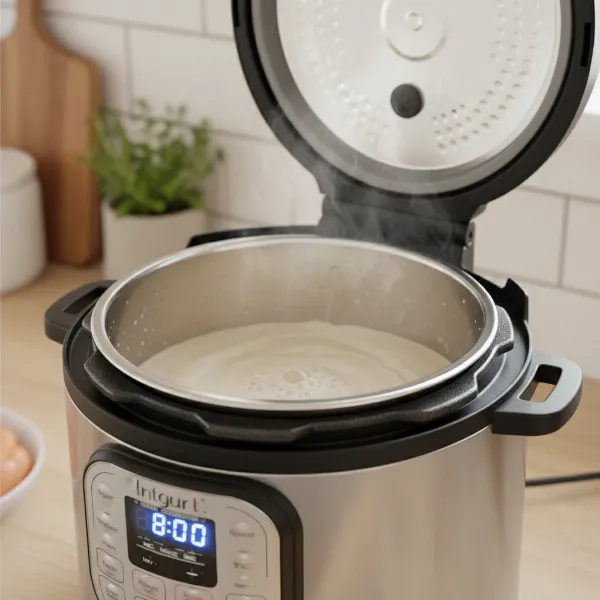 Instant Pot cooking homemade yogurt, showing milk in the inner pot with condensation on the lid
Dedicated Yogurt Maker: Precision for Perfection
In contrast, a dedicated yogurt maker is engineered with a singular purpose: to create the perfect environment for yogurt fermentation. These appliances are designed to provide consistent, stable heat, which is crucial for cultivating robust, creamy yogurt.
How a Dedicated Yogurt Maker Works
Dedicated yogurt makers typically feature a thermostatically controlled heating plate or a water bath that precisely maintains the ideal fermentation temperature. Once the milk is prepared and the starter added, the mixture is poured into individual jars or a large container within the unit. The yogurt maker then holds the temperature within a very narrow range, often ±0.5°F (±0.5°C), for the entire incubation period.
This superior temperature stability is the cornerstone of a dedicated yogurt maker’s advantage. It ensures optimal activity for the starter cultures, leading to consistently thick, creamy, and tangy yogurt with higher viable probiotic counts. Many models are truly “set-and-forget,” requiring no monitoring once the incubation begins. Furthermore, dedicated yogurt makers are typically more energy-efficient during the long incubation phase, often using only about 15W continuously compared to an Instant Pot’s much higher startup surges.
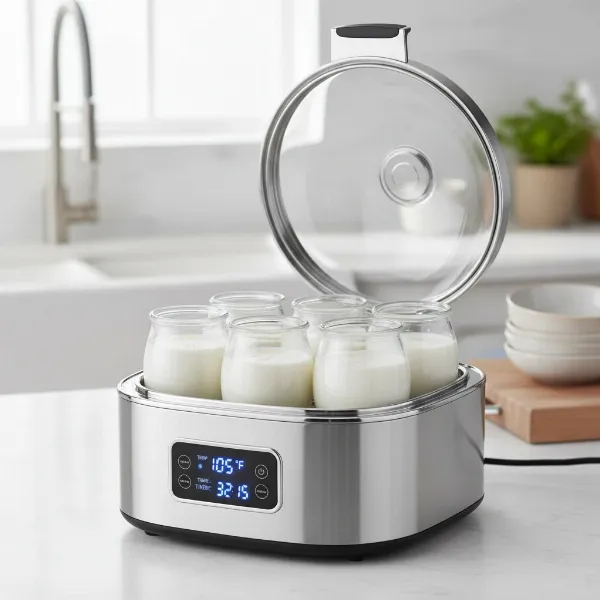 A dedicated yogurt maker with multiple glass jars filled with fermenting milk, ready for incubation
Head-to-Head Comparison: Instant Pot vs. Yogurt Maker
Choosing between an Instant Pot and a dedicated yogurt maker ultimately comes down to priorities: versatility versus precision. Here’s a detailed comparison of their performance in key areas:
| Feature | Instant Pot | Dedicated Yogurt Maker |
|---|---|---|
| Temperature Control | Less precise (can fluctuate ±2.3-3°C/F) | Highly precise (maintains ±0.5°F/C) |
| Yogurt Consistency | Can be variable (thinner, grainier, more whey) | Consistently thick, creamy, tangy |
| Live Cultures (CFUs) | Potentially lower due to temperature shifts | Higher and more reliable counts |
| Ease of Use | Requires some attention/monitoring, multi-step | Set-and-forget incubation |
| Versatility | Multi-functional appliance (pressure cook, sauté, etc.) | Single-purpose appliance |
| Energy Consumption | Higher initial power surge, less efficient for incubation | Lower, continuous 15W for incubation |
| Cost | Often already owned; higher initial purchase if new | Typically less expensive; dedicated for yogurt function |
| Counter Space | One appliance for many tasks; larger footprint | Adds another appliance; often compact |
Key Differentiators: Stability and Results
The most significant distinction between the two lies in temperature stability and its direct impact on the final product. Yogurt fermentation is a “tightly choreographed microbial ballet,” as one food microbiologist described it. A stable temperature environment ensures the lactic acid bacteria can thrive and ferment efficiently, producing a firm gel structure and desirable acidity.
Dedicated yogurt makers excel here, delivering a controlled environment that minimizes syneresis (whey separation) and maximizes viable CFU/mL (colony-forming units) after incubation. While the Instant Pot can make yogurt, its inherent design as a multi-cooker means it may struggle to maintain the pinpoint precision required for truly consistent, high-quality results.
Which One Is Right for You? Making the Choice
The “better” choice depends entirely on your needs and habits in the kitchen.
When to Choose an Instant Pot for Yogurt
- Occasional Yogurt Maker: If you only make yogurt once a month or less, and don’t mind some batch-to-batch variability, the Instant Pot’s versatility might outweigh the need for a dedicated appliance.
- Prioritizes Versatility: You value having one appliance that can pressure cook, slow cook, sauté, and make yogurt, saving counter space.
- Already Owns One: If an Instant Pot is already a staple in your kitchen, trying its yogurt function is a cost-effective way to dip your toes into homemade yogurt.
- Willing to Experiment: You don’t mind potentially thinner batches or slightly more whey, and you’re prepared to troubleshoot.
When to Invest in a Dedicated Yogurt Maker
- Frequent Yogurt Maker: If you make yogurt weekly or bi-weekly and prioritize consistent, superior quality.
- Prioritizes Quality and Consistency: You desire reliably thick, creamy, and tangy yogurt every time, with maximum probiotic benefits.
- Wants “Set-and-Forget” Process: You prefer minimal monitoring during incubation, allowing for a truly passive fermentation.
- Values Precise Control: You appreciate an appliance specifically designed to optimize the delicate science of yogurt making.
Tips for Making Better Yogurt (Regardless of Method)
No matter which appliance you choose, a few universal tips can elevate your homemade yogurt experience.
Essential Ingredients and Sterilization
Always start with high-quality milk. Whole milk generally yields a thicker, creamier yogurt due to its fat content, but lower-fat milks can also produce excellent results. Crucially, use a fresh, active starter culture. This can be a tablespoon or two from a previous homemade batch, or store-bought plain yogurt with live and active cultures. Ensure all your equipment – from mixing spoons to containers – is thoroughly sterilized to prevent contamination and promote healthy bacterial growth.
Optimizing the Incubation Process
Temperature is king. If using an Instant Pot, consider using an external thermometer to monitor the milk temperature during cooling and incubation to ensure it stays within the optimal 108-112°F (42-44°C) range. Avoid disturbing the yogurt during fermentation, as agitation can break the delicate curd structure, leading to a thinner final product. Adjusting the incubation time allows you to control the tanginess: shorter times yield milder yogurt, while longer times result in a more pronounced sour flavor.
Troubleshooting Common Issues
- Thin Yogurt: This is often due to inconsistent temperature, insufficient incubation time, or a weak starter culture. Ensure your milk is heated properly, cooled accurately, and your starter is fresh.
- Excessive Whey: A common occurrence, particularly with less stable incubation temperatures. Draining the whey (e.g., through a cheesecloth-lined colander) can yield thicker, Greek-style yogurt.
- Not Firming Up: Check your starter culture’s viability and ensure the temperature remained stable throughout fermentation. Sometimes, adding a small amount of powdered milk during the initial heating phase can also help thicken the yogurt.
Where to Buy a Quality Yogurt Maker
If you decide a dedicated yogurt maker is for you, they are readily available at major online retailers like Amazon, as well as in department stores and specialized kitchen appliance shops. When purchasing, look for models with precise temperature controls, clear indicators, and a good reputation for reliability. Reading user reviews can also provide valuable insights into real-world performance.
In conclusion, the choice between an Instant Pot and a dedicated yogurt maker for crafting homemade yogurt boils down to a fundamental trade-off: the multi-functional convenience of the Instant Pot versus the specialized precision of a dedicated yogurt maker. For those who prioritize unparalleled consistency, optimal texture, and reliable probiotic counts in their weekly batches, the dedicated yogurt maker stands out as the superior tool. However, for the occasional yogurt maker who already owns an Instant Pot and values its versatility above all else, the Instant Pot offers a viable, albeit sometimes less consistent, alternative. Ultimately, both can bring the joy of homemade yogurt to your kitchen, but only one guarantees a consistently perfect experience.
Frequently Asked Questions
Is Instant Pot yogurt as good as store-bought?
Homemade yogurt, whether from an Instant Pot or a dedicated maker, often surpasses store-bought varieties in terms of freshness, control over ingredients (no added sugars or thickeners), and the sheer quantity you can make for the price of milk. Many users find the taste of homemade yogurt superior.
How long does homemade yogurt last?
Properly stored in an airtight container in the refrigerator, homemade yogurt typically lasts for 1 to 2 weeks. The exact duration can vary based on milk quality, starter culture, and refrigeration temperature.
Can I use non-dairy milk in an Instant Pot or yogurt maker?
Yes, many non-dairy milks like almond, soy, or coconut milk can be used to make yogurt in both appliances, though the process may require specific non-dairy starter cultures or additional thickeners to achieve a desired consistency. Results can vary significantly depending on the type of milk.
What’s the “cold start” method for Instant Pot yogurt?
The “cold start” method, often used with ultra-pasteurized (UHT) milk, skips the initial boiling and cooling steps because UHT milk is already heat-treated. You simply add the starter culture to cold UHT milk in the Instant Pot and use the “Yogurt” setting for incubation.
How much energy does a yogurt maker consume?
Dedicated yogurt makers are generally very energy-efficient during the long incubation phase. Many models consume as little as 15 watts of power continuously, making them an economical choice for regular use.